
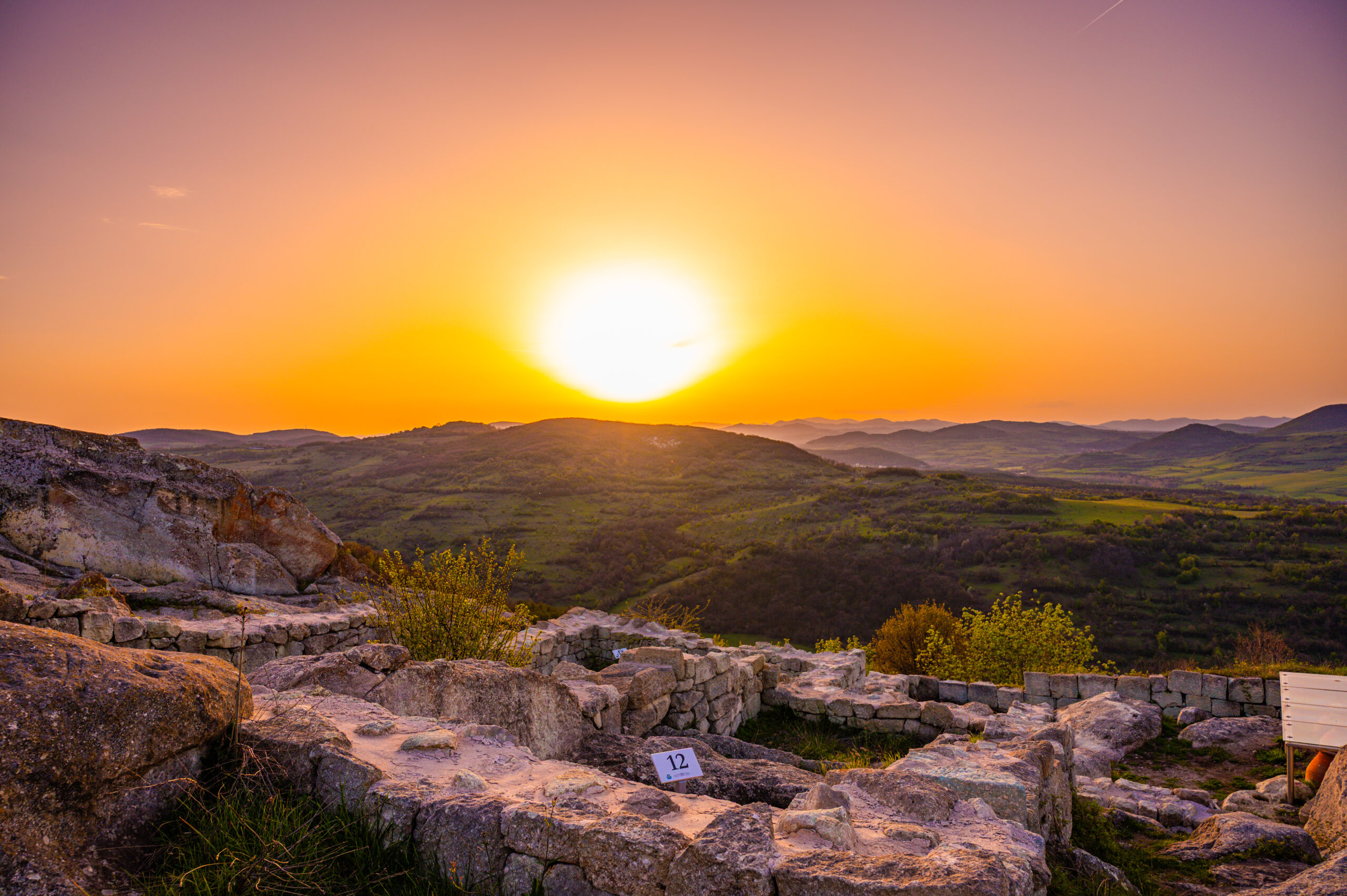

Bronze crosses, ceramics, and jewelry from the 13th–14th centuries were discovered by archaeologists during excavations of a medieval quarter in Perperikon. The crosses were cut up at the end of the 14th century during the city’s conquest. For the third consecutive year, researchers have been working in the southern quarter of the sanctuary – west and north of the large basilica discovered in 2016. According to Ovcharov, the medieval quarter is extremely interesting, even though it is not refined from an architectural point of view.
“It is an important page in the history of the ancient city because this is the period that is best illuminated. There are also many children’s graves. The quarter itself is located literally about ten meters from the main gate of the palace-sanctuary, which is the most difficult to study,” commented Ovcharov. Only a small part of it had been uncovered earlier by Bulgarian researchers, but all the documentation from those excavations has since disappeared.
According to the archaeologist, the Thracian palace-sanctuary is unique in itself. It is shaped like the letter “T,” and the entire complex consists of several interconnected wings. The total area of the ground floor alone is nearly 1,000 square meters, but archaeologists believe there were at least two additional floors. The lower level consists of about 20 rooms.
The main part of the palace is a ceremonial throne room, about 30 meters long.
There are also two temples within the palace. One was most likely dedicated to the god Mithra, and the other to the dead. The latter includes 12 tombs with underground chambers, though they have been looted. Particularly interesting, according to the archaeologist, is the hall with the altar, which is connected to the palace. It is three meters high and is believed to have been used for oracles.
“In this hall, the wine-and-fire ritual was performed, which, as scholars Alexander Fol and Ivan Marazov explained years ago, was the method the Thracians used for divination. All this leads us to believe that this oracle was dedicated to the Thracian Dionysus described by Herodotus,” explained Ovcharov. According to him, the sanctuary originated at the transition between the Bronze and Iron Ages, at the end of the 2nd and the beginning of the 1st millennium BC.
The exploration of the rock city has been ongoing for 19 years, and its history will be documented in a book by Professor Ovcharov. Excavations for this season will conclude in about a month, and for the past 3–4 years, researchers have been routinely using drones in their work.


